

|
|
 |
|
 |
April 27, 2007
|
|
 |
An anonymous reader sends in this comment:
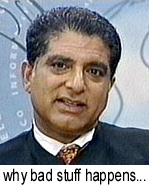
CNN had an interview with Deepak Chopra on Wednesday, April 18, asking him for commentary and advice on the Virginia Tech massacre. They wanted him to tell us "why bad things happen to good people, and where is God in all of this."
As he usually does, Chopra dispensed a bunch of “feel good” jabberwocky that was a gross insult to the entire tragedy.
Chopra responded with his familiar line about how the collective consciousness of humanity working together can uplift the human spirit and make for a better world. He side-stepped the question of God by rambling on about how there isn't really a personal God in the sky, that God is really a form of personal spirituality among us all. For those familiar with his many books, articles, and conversations in Internet-based interviews and such, they'll know the man has a number of pet crackpot "scripts" he's memorized, and he spouts minor variations of them at every opportunity, adapting them, it seems, to any situation.
When asked at the beginning of the interview about God in the face of such a horrific event as the school shootings, Chopra's most intelligent comment was to say that the question should really be about how a young student could walk into a gun shop and easily purchase a gun. Good comment, but I'd never seen a more slippery evasion of the actual question concerning God. The question of gun ownership by U.S. citizens, not so incidentally, is also something most of Europe and rest of the very puzzled “free world” now seems to be asking about a seemingly politically-moribund, violence-loving, NRA dominated, gun-happy America.
What CNN got for its efforts was the silly ramblings of a pseudo-mystical “guru” who has garnered a massive following, becoming a multi-millionaire author in the process, thanks largely to a pandering media that hasn't the slightest interest in giving equal support for scientific reality or rebuttals. Discerning individuals with even a moderate (i.e. layman-level) scientific education would have seen that Deepak Chopra had very little – if anything – of substance to say, that could in any way ameliorate this terrible, terrible tragedy.
It makes me wonder what's next: televised commentary and "psychic advice" to the bereaved families and friends of the deceased from Sylvia Browne? ...It wouldn't surprise me. I think my own "psychic antenna" can faintly hear Montel Williams and Larry King rushing to call her up right now over this tragedy, as I speak....

While we’re on the Sylvia subject, reader Leif Wright tells us that in her latest appearance on Montel Williams' show, a woman in the audience, obviously a woo-woo, piped up and declared that she was convinced she’d had a “past life” as the wife of Persian emperor Darius III and had died during childbirth. This is an excellent situation for The Talons to exploit, but she blew it.
This woman, not at all shy about her previous-life debauchery, said she thought that maybe Alexander the Great had actually been the baby's father. No concern was given to Darius’ thoughts about such carrying-on, and Browne, in her infinite wisdom and all-seeing perspective, said:
No, Darius was the baby's father, and the baby grew up and was in the court of Saladin.
Well, there’s a serious problem here, as reader Wright points out:
Darius III died in the 300s BCE. Saladin was born in 1137 A.D., so not only is Sylvia Browne saying this woman was the wife of a Persian emperor, she was saying the woman's son lived 1,400 years.
Shucks, Leif, you know that (a) Sylvia will invent a new paradigm to accommodate what we ordinary folks might think is a serious error, and it won’t faze Montel one bit; he’s got his eye on the cash register, as always.
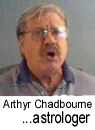
Reader David Smith sends us to www.youtube.com/watch?v=SljcuLz500I, where we find an astrologer chap named Arthyr W. Chadbourne rattling on about how the JREF challenge doesn’t exist. Doesn’t he wish! He offers various other very purposeful and intended distortions of what we’re all about, as obfuscation. I refer you here, so that you may see just how desperate these folks are to dodge the challenge, and to avoid having to prove their claims. They construct totally false premises, fictitious scenarios, but those that would provide a situation impossible to handle. Let’s get real – proving any astrological claim should be simplicity itself, so the believers must construct a philosophical shield around it to make it – if their definitions are accepted, unprovable. Mr. Smith comments:
Many people had urged [Chadbourne] to take the challenge, but like the ass-trologer you mentioned in SWIFT last week, he says stuff like "We have nothing to prove!" And of course, the woo-woo's favorite: "You can't prove it scientifically, astrology has NOTHING to do with science!"
Well, according to his bio, Chadbourne is a third generation astrologer, so apparently no amount of evolution is going to improve his line one bit. Or, more likely, all three generations of Chadbournes found early on that the public fascination with nonsense is strong enough that they can make a very handsome living just by exploiting that fact.
A few examples of Chadbourne’s imaginary problems with the JREF challenge:
#1: Mr. Chadbourne strenuously states – in so many words, at 01:34 – that “Astrology isn’t a science, it has nothing to do with science,” and goes on to proudly say that therefore he can’t “prove it scientifically.” Sir, let’s just drop any scientific standards here, shall we? That’s so you won’t be frightened at the possibility that reason might rear its fearful head. We’ll retreat to looking for evidence on the lowest level you can inhabit. How about: simple proof? You make a claim about what astrology can do, and we’ll agree on a simple, easy, basic, test of that claim. Or is that too much for you to handle? Remember, the prize is a million bucks, Mr. Chadbourne. I’ll bet that even you will find this an attractive carrot to snap at…!
This ploy by Chadbourne – of denying any relationship between astrology and logical thinking – is introduced in order to hopefully take it beyond examination by any rational, logical, system. Now, I agree with his view of astrology – it is mythology, it is nonsense, it is irrational. But even mythological, nonsensical, and irrational notions, can be examined…! Yes, really!
#2: Mr. Chadbourne claims – at 02:06 – that the JREF challenge doesn’t exist, then goes on to blather about just why he has developed this notion. He says – at 02:12 – that I would require the astrologer to “prove to [me] with [my] methods, what [astrologers] do.” Nope. Nothing need be proven to me, as we very clearly state in the rules. An independent agent – one acceptable by all concerned – will be decided upon, and will conduct the test, which will be designed in such a way that no decision need be made; the result must be evident to any observer.
#3: Mr. Chadbourne tells me – at 03:04 – that I “have a problem in defining what astrology is.” Well, no. It’s for him to (a) define what it is, (b) say what it can do, and then (c) design a test to establish that claim. How much clearer can that be, sir? Or do I strain your intellect?
#4: Mr. Chadbourne avers – at 04:34 – that “We can’t step into your arena and do things your way.” True. That’s why we do them your way, sir! See #2, above.
#5: Mr. Chadbourne says, at 04:50, “You have no idea what you’re claiming.” Duh. I’m not claiming anything, sir. I thought that you were making a claim, and I listened to every word of your five-minutes and thirty-five seconds of blather, hoping to learn what your claim might be, and all I got was that astrology is “a principle” that you use “in a mathematical way”! Double-duh. TO DO WHAT, SIR? Just what do you claim astrology can do, Mr. Chadbourne?
If direct questions offend you, that’s too bad, Mr. Chadbourne. That’s the only kind of question I know how to ask…

From Cape Town, South Africa, comes the startling news that AIDS cannot be cured by wishful thinking. In fact, an advertisement for a religious campaign by the badly-bewigged scam artist Ernest Angley was ruled out of order by the Advertising Standards Authority [ASA] in that country. An ad for the "Miracle Crusade with Reverend Angley" claimed – among other things – that Angley, an evangelist based in the United States of America, can cure AIDS. His website says that people can be healed by putting their hand against his on a computer or television screen, a stunt started by evangelist Oral Roberts back in the 1950s, first on radio, then on TV.
The ASA requires advertisers to have documentary evidence to support all claims capable of "objective substantiation,” a challenge that Angley could never meet. The ASA said it had tried unsuccessfully to get a response to the complaint, but the advertiser had "failed to provide the ASA with verification of the claim in question." Wisely, though rather obviously, the ASA also said that though an element of faith could be involved when viewing advertisements such as this,
Caution should be taken when referring to HIV/Aids, as an incorrect assumption based on religious faith could result in further infections.
Yes, and death, that’s correct, and the present miserable and tragic state of the African continent in this regard, stands as proof of that fact. As reader Owen Swart says:
Although it’s alarming that Angley was able to publish those ridiculous claims in a supposedly credible newspaper to begin with, it is inspirational that there are fellow South Africans dedicated enough to the pursuit of truth and the banishment of credulity that these ridiculous claims don’t go unchallenged.
Thank you, Owen. I find it incredible that the public should still have to be told (a) that Angley is a fraud, and (b) that wishful thinking will bring about cures of deadly diseases…
While we’re in South Africa, reader Allan Taylor comments:
We've corresponded before about Matthias Rath and his activities in South Africa. The Treatment Action Campaign continues to pursue him vigorously in the courts.
Fortunately the obfuscation that has surrounded HIV/AIDS in South Africa has largely dissipated over the last year with the ongoing incapacity of the Minister of Health who recently underwent a liver transplant. The Deputy President and the Deputy Minister of Health are much more activist and rational in promoting the conventional views of HIV/AIDS and its treatment including the roll-out of ARVs [anti-retroviral drugs]
We have to wonder why the Minister of Health opted to undergo an operation – a liver transplant – rather than gobbling down herbs and listening to chanting, which are recommends that AIDS patients do instead of orthodox medicine…

Last week's mention of a quack device inspired reader “Calvin” to send us to www.sciplus.com/category.cfm?subsection=7&category=87 to see the second item on that page. Click immediately below the illustration, on the camera icon. Says Calvin:
After reading the article in SWIFT on "The Tesla Shield", I recall seeing those same pill containers advertised in the American Science & Surplus catalog at $3.75 for a package of three. Compared to $89.95 for one, that's a real bargain! Thanks for a great site! Well done!
In 1950, author Alfred Still published “Borderlands of Science,” a copy of which came to my attention recently when I added it to the shelves of the JREF library. It is a remarkable book, listing “Divining Rods,” “Levitation, Poltergeist Phenomena, Hypnotism, Telepathy, Precognition, and Faith Healing” as chapter titles. And, I shudder to say, the author accepts them all as true, proven, and worthy of embrace. Under “Divining Rods,” he heads the closing section under “Doubts and Conjectures,” summing up his opinion of those obstinate persons who still doubt that dowsing works:
The monumental conceit of intellectual man probably accounts for the fact that some philosophers and many scientists have assumed the prerogative to deny the existence of what they cannot understand. Since ignorance rather than knowledge habitually denies whatever is unfamiliar, it is not unreasonable to assume that if the man of science had a less exalted opinion of his own talents and achievements, he would be more willing to investigate such borderline subjects as the mysterious art of the water diviners. The scientist has been accused of being chary of overstepping certain recognized boundaries, because he fears to discover new knowledge which might disturb and perhaps upset his well established and generally accepted theories. This suggests a lack of courage, which is far from being a failing of the true scientist. A more charitable explanation would be that the scientist constantly overlooks what he no longer denies, namely that his theories, based on experimental findings, do not inherently possess an absolute standard of truth; they are merely guesses or approximations, to be held tentatively until disproved by further experimentation. The scientist would be more broadminded and less contemptuous of the dreamer or mystic if he always remembered that what he confidently regards as the truth is little more than a zealously cherished opinion.
I must butt in here to remark on the shallow accusation Mr. Still makes against the hypothetical “scientist” he insults here. No real scientist “fears to discover new knowledge,” and will have no “well-accepted and generally accepted theories” that have not been thoroughly re-examined and tested, repeatedly. This canard is one frequently introduced by the uninformed fanatics who are really the ones who fear that their notions will be shattered… Next, Mr. Still retreats to poetry for proof of his claim that merely believing something to be true, makes it so:
What a man believes is of enormous importance, not only to himself, but also to those – his disciples or followers – who look up to him as their guide or teacher. There is a passage in the Bhagavad-Gita (The Song of the Blessed) which reads: "Man is made by his belief. As he believes, so he is." The scientist believes that his disciplined thinking mind is capable of probing the universe and solving the perennial riddles of the physical world. He disparages the power of imagination, and rates intuition below reason. But we are a long way from having attained an era of pure unadulterated reason, for which some of us are unreasonably thankful, while others are utterly incapable of imagining a world of men so fundamentally different from the world they know. In the meanwhile, it seems foolish to belittle imagination or overlook the importance of intuition. We have a passion for theorizing, which tends to lead us astray. Many of us fail to recognize that what we gain through intuition – what, without burdening the intellect, is "given with immediacy," may be of great value, not merely to ourselves, but to mankind. It is not suggested that the modern physicist should cultivate a delirious imagination, but he might at least recognize the existence of those who claim that knowledge gained through ratiocination does not include all the knowledge of his environment that is available to man.
Yes, Mr. Still, “the scientist believes that his disciplined thinking mind is capable of probing the universe and solving the perennial riddles of the physical world.” He – or she! – provides proof of that, every day, to our benefit, our survival, and our delight. But when you declare that this same hypothetical scientist “disparages the power of imagination,” you are quite wrong, and your ignorance of science is again shown to be abysmal. However, you almost regain some semblance of rationality when you follow with, “[the scientist] rates intuition below reason.” If, by “intuition” you mean – and I strongly suspect you do – a mysterious, mystical, magical, sensory process, I agree with you. Such a chimerical notion, that mysticism should be equal to or greater than rationality, is medieval. I would suggest that you take up astrology, but I see, in your book, that you reject this “art,” because the German philosopher Albertus Magnus – who you much admire – denied that it had any value…
Mr. Still pursues this “belief” notion on behalf of the constantly-failing dowsers, making excuses for that obvious feature of their delusion, writing:
There appears to be something of intuition, something psychic in the dowser's art which calls for a belief on the part of the investigator in the possibility that mind is, to a limited extent, able to control matter. The theories which are so highly prized by physical science ….
Here we go again, blaming the investigator for the failure of a test, because not enough faith/belief was summoned! Mr. Still uses references from Albertus Magnus (1193-1280) and other mystics of that vintage, as if they were just as valuable as those offered by hard-nosed modern researchers, and he tosses out quantum physics and relativity theory as
…seem[ing] to belong as much to psychological as to physical science.
I see this as an admission that these concepts are beyond the man’s grasp, and thus elements that he need not bring into his thought processes. He is unshakeable in his notions, in one of which he states:
…but the hypotheses of the medicine-man and the mystic are not those of the scientist. The latter relies upon his reasoning mind to create the "laws of nature" which "explain" the physical universe as it appears to him; but he is not justified in assuming that what he discovers is more "true" than what the religionist sincerely believes to have been revealed to him in a manner which the unbeliever does not and cannot understand.
Yes, “discoveries” have been made by the amateurs as well as by the pros, sometimes by accident, more often by careful observation and record-keeping. Certainly, before the scientific process was established, trial-and-error – as with herbal treatments – was depended upon for results. But each such finding is only as “true” as constant trials will support – a process that real science insists upon. Just where are these revealed truths that you say the religionists have given us? Divining, levitation, poltergeist phenomena, hypnotism, telepathy, precognition, and faith healing, perhaps…?
Ah, but I bore my reader with such meanderings. Author Arthur Still, with books on electrical engineering to his credit, has probably enabled many students to wire up stereo equipment without frying their bodies in the process, but their minds might not have survived as easily…
Reader Scott Hurst sends me this disturbing item, taken from scienceblogs.com/pharyngula/2007/04/what_are_you_doing_al.php. It means either that Al Gore will do anything to make a point, or that he actually believes what he says here…
Al Gore is generally a good guy, and I think his message on global warming is an important one. He's still traveling around, giving his slideshow that we've seen in An Inconvenient Truth, but apparently he has added some new material — and these aren't slides that make me very happy.
The slide I found particularly interesting/shocking/sad, was his new(?) slide containing a graph of human population growth over the past couple hundred-thousand years. It started off good. He pointed at the beginning of the graph, showing the population of humans on Earth from 200,000 years ago, and referred to the "rise of humans."
Cool beans. So he believes that Homo sapiens evolved from other hominid ancestors, right? Nope. In the very same breath, he then continued to explain that according to his religious beliefs, this "rise of humans" was God's creation of mankind — apparently 200,000 years ago. His graph then changed to include the caption "Adam & Eve" above this starting point.
Wha…?
He might as well have shown the chart of global temperature vs. number of pirates — it's nonsense that completely undercuts the seriousness of the science he's discussing.
It's strange how this one little slide makes me far less enthusiastic about the prospect of another Gore run for the presidency. Even if he doesn't actually believe in a literal creation event for mankind, he's not above pandering to the ignorant.
This has me very concerned…
The NBC-Today Show last week got all excited over a news item from the astronomy world that a planet has been discovered with very Earth-like features, in our own galaxy, and even showed a photo of the object, though, since it could hardly be more than a few pixels in size, that image was an imaginary guess.. They titled the bit, "Are We Alone?" That, to me, is rather jumping the gun. You see, this planet they were rhapsodizing over is 20 light-years away from us. That's 120,000,000,000,000 miles away, folks, and I don't really see much possibility that we'll be going there in a hurry, even when we finally develop the means to do so. As for us being alone, with the almost-infinite number of possibilities presented by the universe, I think the answer to that is, definitely not. A newly discovered life-form might only consist of some sort of mold, or it might be a bug-eyed-monster. In any case, the news from the new planet is going to take a while to get here.
British bookmakers, who are supposed to know very much about the real world and how it works, were stirred to action by this announcement of the new planet. They panicked. You see, in the early 1960s they’d offered 1000 to one odds on whether or not a human being would be walking on the Moon before 1970, and they lost big time on that wager. Presently, they have bet against the discovery of extraterrestrial intelligence, giving those same odds. Alarmed by news of this new planet, they slashed the odds down to 100 to one. And, they have as a condition of paying out on their wager, that the Prime Minister has to confirm officially the existence of intelligent extra-terrestrial life and it has to be done within a year of the bet being placed.
I think the British bookies are pretty safe...

©James Randi Educational Foundation Typos? Format Problems? Please contact the Webmaster |


