
| Table of Contents: |
We were recently heartened by the news that Britain's leading scientific institutions have declared that unwise changes in the regulation of homeopathic medicines are putting patients at risk. More than 700 doctors and scientists have signed a comprehensive statement opposing new rules which allow homeopaths to make actual medical claims for their “preparations.” Countering this well-stated objection, the Medicines and Healthcare products Regulatory Agency (MHRA), Britain’s drug regulatory agency, claims that the new rules they initiated would actually benefit patients. In effect, the regulation of medicines in the UK has officially moved further away from science, than towards it.
In September, the MHRA introduced rules to allow homeopaths to specify the ailments for which their “remedies” can be used, without the need of any supporting evidence. The Royal College of Pathologists, the Medical Research Council, the BioSciences Federation, the Physiological Society, the British Pharmacological Society, the Society for Applied Microbiology, the Royal Society the Academy of Medical Sciences, along with four other national societies are alarmed that claims can now be made about efficacy of these products without rigorous and objective evidence. It appears that this MHRA decision is in surrender to powerful pressures brought about by the quackery industry. And, we suspect, HRH Charles is applauding this retreat into mythology.
Homeopathy is a system of therapy based on the notion that disease can be treated with drugs diluted beyond any discernable presence, and can be effective. Under these new MHRA rules, homeopathic products will receive a license if they can only provide evidence that the treatments are safe, which is evident because of the billions-to-one dilution. Indeed, concentrations of some compounds used in homeopathic “remedies” are often not as heavy as the amounts found in the natural tap water used to swallow the pills! A recent study in the Lancet – one of the "core" general medical journals, published in the UK – suggests that the benefits of homeopathy are all in the imagination, with alternative remedies performing no better than dummy pills in clinical trials.
Ah, but there is one requirement the homeopaths must meet: they must show that the product has previously been prescribed to treat those particular conditions within the homeopathic industry. Whether any improvement or relief was obtained, they need not show. This is like referring to Shakespeare’s Macbeth to establish that since “eye of newt and toe of frog” were used in Scottish medicine around 1040 C.E., these substances should be endorsed – and such a reference is just as authoritative as that of the MHRA.
Lord Dick Taverne, the chairman of Sense About Science – an independent charitable trust concerned with the misrepresentation of science and scientific evidence – at a House of Lords debate on the regulation change, said:
As many of the medical specialists contacting us have pointed out, evidence-based medicine has been a major public gain of the 20th Century. This is the first time, since the thalidomide tragedy and the 1968 Medicines Act, that the regulation of medicines has moved away from the science rather than towards it.
Of course, authority Dr. Peter Fisher, homeopath to Queen Elizabeth II and clinical director of the Royal London Homeopathic Hospital, was quick to obfuscate. He claimed:
The regulations just tidy up the situation by saying “this homeopathic medicine has been traditionally used for” and it brings it into line with the regulations for herbal medicines
I take Dr. Fisher back to Macbeth, and the “traditional use” of newt’s eyes and frog toes. He added, typically dismissive of such powerful opposition:
I think it's a bit of a storm in a teacup.
I presume the tea is made with the tiniest scrap of tea-leaf diluted millions of times, doctor? Oh, too strong…?
Dr. Edzard Ernst, professor of complementary medicine at Exeter University, said about this:
[The ruling] makes a mockery out of evidence-based medicine. I feel very strongly that this is a very serious mistake. If there are claims being made, there has to be evidence for them... Taken to the extreme, this regulation could cost lives.
Michael Baum, professor of surgery at University College London, accused the homeopathy industry of playing on people's beliefs in magic and superstition:
Homeopathy websites advocate using mistletoe to treat breast cancer. The [proof of the efficacy] for mistletoe is that it grows on the bush in a way like cancer grows in a person. It is utterly barmy.
But an MHRA spokesman claimed that quality and safety were “tightly controlled” by the industry:
The label and/or packaging must have a clear statement of the homeopathic nature of the product, with a statement instructing the patient to consult their doctor if symptoms persist.
This is “tightly controlled”? It would appear that the Webster and the Oxford dictionaries are in conflict here…

Correspondent Carl Moreland, a tireless investigator/critic of dowsing/divining devices, informs us:
Our good friend Thomas Afilani (Electroscope & DKL Lifeguard, a.k.a. dowsing rods) now has a personal web page, www.thomasafilani.com. The single most powerful phrase on the web site is, "The Proof is in the Patents." This is an excellent example why the USPTO [United States Patent & Trade Mark Office] must be held to task for doing what should be their job. Too many people, even smart people, assume that a patent really is proof.
Go to www.randi.org/jr/050605free.html for one of our items about Mr. Afilani, and know that the satisfied user of his device was, as you’ll see, offered the JREF million-dollar prize if he could support his claim that the dowsing-rod worked. We never heard from him again, strangely enough. We have to wonder whether the enthusiastic customer was related to Afilani, or perhaps occupied his skin… Both of these folks declined to accept the million…
Happily, not all countries have as naïve an agency as the USPTO. A French scientist, Professor Yuly Zagyansky, claims to have discovered a new magnetic force that appears to support both flying carpets and perpetual motion. He first applied for a patent more than five years ago, but the European Patent Office (EPO) rejected his application for failing to describe a patentable invention. Zagyansky appealed, pointing out that the EPO had failed to find any evidence of prior art – and therefore that his “invention' should be patentable. The EPO reasoned that the absence of prior art is irrelevant if an application makes no sense. It simply could not understand what Professor Zagyansky was talking about in what he called a "revolutionary scientific theory of century [sic]".
Judge for yourself. The title of Zagyansky's invention is:
Einstein-Bohr end: new atomic scale physics, electric field: neutrinos and electrons in conversion, perpetuate motion. Development: seisms extinguished volcans, created islands, big-bang energy.
How does his Earth-shaking invention work? He claims, in language we all understand:
The process of the elimination of the electric and gravitational fields characterized in that one eliminates (or almost eliminates) the electric or gravitational field in eliminating the electronic neutrinos and antineutrinos of the corresponding surrounding space with the help of the T-rays, transforming them into the electrons and positrons, easily eliminable/for, for instance, the Perpetual Motion Machine in separating the charges without the work and re-putting the field or for the “Flying Carpets” of the transport/according to Claims 4 (6,7).
Duh. A previous application from the Professor discussed “Aeroplane Carpets,” perpetual motion, and evidence of other universes. The EPO's Board of Appeal – quite rightly, in my opinion – decided that their office was set up for granting patents, and not to serve as a discussion forum for new physical theories unless these are unambiguously proven, are of a technical nature, and are capable of industrial application. So, you see, there is hope.
As further encouraging news of encroaching sanity in high places, we must report that a German woman in Munich has just won a lawsuit against a “love witch” who failed to induce her ex-boyfriend to come back to her embrace by means of rituals performed under the full Moon, rituals designed to cast a spell over him. The witch was ordered to return her €1,000 (US$1,300) fee and to pay “several hundred euros” in court costs. The court ruled that this service was
…objectively impossible to render… and a ritual not suited to influence a person from a long distance.
We have to wonder: are there witchcraft rituals that are suited to influence a person from a long distance? Or is this a peculiarity of translation…? Reader Kale Gannan commented, referring to a media release on this story:
My favorite line is the one at the end: "The witch said she never guaranteed the spell would work." And that's why you should only go to licensed and bonded witches for your love spells, instead of these fly-by-broomstick operations.
Of course!

The Theatre of Science show is coming! Those of you in the New York City area – or who are willing to travel to see a spectacular limited-engagement show that will straighten you up in your seat with real wonders from a huge scientific grab-bag – should make note of this. At the “Theatre for the New City” between Thursday, November 9th, and Sunday, November 12th, Professor Richard Wiseman, Psychology Department, University of Hertfordshire, and his colleague Simon Singh, particle physicist and science journalist, will be performing a show which is sponsored by Skeptical Inquirer magazine and the CUNY Graduate Center, Science & the Arts Program.
There’s a closing scene to this remarkable show in which a hapless volunteer is placed in a Faraday Cage – look it up on Google – and has the delightful experience of a million volts – six-foot-long bolts of electricity – blasted at him with the hope that he will not be fried in the process. I’ve had experience with this procedure, and from what I’ve been able to learn, by far the greater percentage of volunteers survive nicely. JREF member James Dillon has bid over $500 – which goes to our scholarship fund – to go into the cage at the 3pm matinee show on Saturday, November 11th. Mr. Dillon would like to have many JREF people there to watch his possible demise. Attendance will include an invitation to any burial ceremonies that might ensue…
Please refrain from commenting, “Well done!” following the performance…

There are details at www.theatreofscience.co.uk, and the photo here shows the Faraday Cage during one of its performances – in this case, a successful one.
Lucky theater-goers will also see what Richard describes to me as
…the remarkable anatomy of Delia Du Sol, one of the UK’s top contortionists, as she performs live, demonstrating impossible body bends and squeezing into a tiny Perspex [that’s Lucite or Plexiglas, over here] cube.
This giddy group will also feature mind-blowing optical illusions, a live lie detection polygraph demonstration, and an explanation of the Big Bang trimmed down to two minutes. The sell-out show has been staged to rave reviews in London’s West End and at the Edinburgh Fringe Festival. Those who have attended any TAM function already know how entertaining Dr. Wiseman is.
This is an excellent – though brief – opportunity for JREF folks to meet the Theatre of Science performers and to support a good cause: science education. Their unique way of presenting the facts about the universe while titillating the audience, should be encouraged. I have never forgotten a University of Toronto professor who used to perform a somewhat less involved – but highly entertaining – lecture for the public. See http://tinyurl.com/y2tj4p.
An unsigned note arrived commenting on a point I made in last week’s SWIFT under the item “Misapplied Expertise”:
In reading your most recent commentary, it seemed to me there was a possible misunderstanding on your part about what Dan Thompson had written.
In your response to him, you say: "Dan, I sense here an implication that psychics actually have something going for them besides tricks and subterfuge..." I was unable to see anything in what he had written which implied that, and was wondering if perhaps you had misread the sentence in which he wrote "Of course, such an analogy would be completely nonsensical and has nothing to do with the way real physics work..." as "…and has nothing to do with the way real psychics work..."
I began a thread on this at JREF, then realized later it might have been more sensible to write you directly asking if you might have made such a mistake. So, better late than never, I thought I would write you inquiring about this (and calling it to your attention, in case you did slightly misread what Thompson had written).
Thank you for the many years you have put into combating frauds and swindlers. I have been an admirer of your writing and work since the mid-70s, and am very grateful to you for creating JREF (and for the forum hosted there).
Properly admonished and flattered, I responded:
The expression “real psychics” would have implied that there are genuine psychics… Yes, it appears that I mis-read that, probably because of the use of the plural verb case. It should have been: “…the way real physics works,” since “physics” is a singular noun, and uses the singular verb case. And, I very frequently find the use of “physics” and/or “phsychics” when “psychics” was intended. But that’s a poor pair of excuses…
Mea culpa…

I stole this directly from the September issue of American Atheist – www.americanatheists.org. I added a touch or two of my own…
Q: How many Theists does it take to change a light bulb?
Charismatic: Only 1
Their hands are already in the air.Pentecostal: 10
One to change the bulb, and nine to pray for protection against the spirit of darkness.Presbyterians: None
Lights will go on and off at predestined times.Roman Catholic: None
Candles only. Put a little something in the box.Baptists: At least 15
One to change the light bulb, and three committees to approve the change and decide who brings the potato salad and fried chicken next Sunday.Episcopalians: 3
One to call the electrician, one to mix the drinks, and one to talk about how much better the old one was.Mormons: 5
One man to change the bulb, and four wives to tell him how to do it properly.Unitarians: ?
We choose not to make a statement either in favor of or against the need for a light bulb. However, if in your own journey you have found that light bulbs work for you, you are invited to write a poem or compose a modern dance about your light bulb for the next Sunday service, in which we will explore a number of light bulb traditions, including incandescent, fluorescent, 3-way, long-life and tinted – all of which are equally valid paths to luminescence.Methodists: Undetermined
Whether your light is bright, dull, or completely out, you are loved. You can be a light bulb, turnip bulb, or tulip bulb. Bring a bulb of your choice to the Sunday lighting service and a covered dish to pass around.Scientologists: Tom Cruise
We may get lucky and he’ll fall off the ladder, or will be kidnapped by Xenu.Nazarene: 6
One woman to replace the bulb while five men review church lighting policy.Lutherans: None
Lutherans don't believe in change.Amish:
What’s a light bulb?
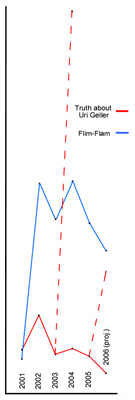
I noted an interesting trend when looking over recent JREF book sales. Now, such sales are a minor source of income for us; the service is maintained more as a convenience for our members and fans, so this chart does not represent outside sales of our books. Only two – Flim-Flam! and The Truth About Uri Geller – are charted here, but it is very evident that the book on Geller is hardly of any interest any more. We probably will not re-order it. Flim-Flam! continues to do well, both from our office, and in the bookstores.
New England College in Henniker, N.H., has ordered copies of the
Geller book from JREF – 150 in the last few years – as text books for
their course, "The Way of Science," which was begun there 25 years ago
by Michael Wirth. It's taught today by Sachie Howard, and you can
learn more by going to the college site at www.wayofscience.info/unit1part1.html and seeing the pertinent
questions that are asked about the spoon-bender and his pretensions.
Remember, Geller has always said that he doesn't care what people say
about him so long as they spell his name correctly – though he's sued
a few folks because he didn't like their attitudes. I'd think that
this New England College course might get his rapt attention…!
The dotted red lines in the chart would properly represent the actual
JREF sales of the Geller book with the textbook sales added.
Reader Ken Dauer observes:
The recent discussions about hoodwinking otherwise smart and well-trained people brought to mind something that happened to me a few years ago. The felt-tip pens my employer provided were made of plastic and had a curved, sharply pointed cap. One of my co-workers (an electrical engineer) discovered that if you squeezed the cap hard enough between your index finger and thumb, the cap would shoot out with some force, like a pumpkinseed.
Dan would show a pen to a young engineer, and explain that the polyethylene material of which the pen was made could store a significant static electrical potential if suitably charged. He'd place the butt end of the pen against the screen of a computer monitor (they of course are known for developing an electric charge) and hold the cap between his thumb and forefinger a short distance away from the point of the pen. Suddenly the cap would fly out from between his fingers with enough force to firmly snap itself in place over the point of the pen; supposedly the electrical charge on the pen had attracted the cap.
He had a pretty significant success rate in fooling well-trained engineers, up to and including PhDs, with this trick. If he had explained that it was magic, or that "spirits" were responsible, nobody in that audience would have believed him, but he linked the trick with their real engineering knowledge well enough to make the supposed phenomenon entirely plausible. Plastic rods are a staple of demonstrations of static electricity, and computer monitors sometimes do develop a noticeable static charge.
He probably would have fooled me too, but I had known him long enough to know that Dan was (and is) something of a practical joker. If he came to you with a "demonstration" like that, there was a nonzero chance he was pulling your leg.
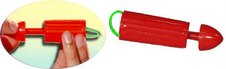
Well, Ken, study the illustration here. This is a standard pocket-trick called The Red Snapper – no relation to the fish – that you’ll find in any magic trick store. It works just the way the Dan trick works, but it has a green rubber band jammed into the end, to give the impression that the operator is somehow engaging that band to cause the action.
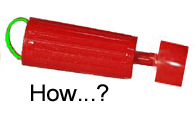
Now that I have your interest, I’ll tell you that there is another version of The Red Snapper available – one of which even most magicians are unaware. It’s usually made of metal, but the second illustration shows a plastic version that would work just as well. How does this one work? By an entirely different principle: no magnets, no added gimmicks, no chemicals, no springs or rubber bands. And, it’s very simple, as simple as the regular Snapper! Give me your best solution…!
One of our faithful volunteers, Chris, has been laboring away at getting the JREF library into shape. He’s added another 150 books, bringing the total – not counting encyclopedias (we have five of them) and the 67 journals we collect – to 1,899 volumes. We had to extend the library shelves outside the room and around the corner down the hall. Hidden away in my office is the conjuring library – stuff too good and secret for the peasants to get hold of. That’s another 60 books. Our video collection, which went from ¾” tape format to VHS and now to DVDs, stands at 762 discs, some containing as many as 5 or 6 items. That’s a lot of data, folks, and it’s all available to archive this strange period in history when the public opted to ignore what they’d learned since science came along, and decided to listen to the scam artists and religious nut cases who moved in on them.
Volunteers Keith and Elena have been industriously trimming, combing, and grooming the new Randi dolls for sale; we expect a good reaction to that item, especially now that we’ll have 3 – count ‘em – 3 – sturdy voodoo pins with which owners may torment the figure. The attached handcuffs will be obvious, but there’ll be a concealed feature that will only be encountered when the doll is carefully examined…
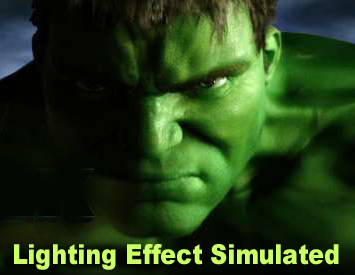
I’m currently seeing a commercial advertising Philips TV receivers in which an actor is shown looking into his bathroom mirror and changes a là Hulk/Bill Bixby into a green monster. As the green effect becomes evident, a subtitle fades in: “Lighting Effect Simulated.” Gee, folks, I wasn’t fooled, even for a minute. I figured it all out right away! What’s going on here? Do advertising standards require that viewers must be informed that the actor didn’t really get magically transformed, that this isn’t a “faith-based” miracle?
Old friend Ken Hughes sent me to www.thepregnancytester.com and I entered the required data. Try it…
Thought for the day:
No theory is too false, no fable so absurd, no superstition too degrading for acceptance when it has become imbedded in common belief. Men will submit themselves to torture and to death, mothers will immolate their children, all at the bidding of beliefs they thus accept. – Henry George, “Social Problems,” 1883.
